

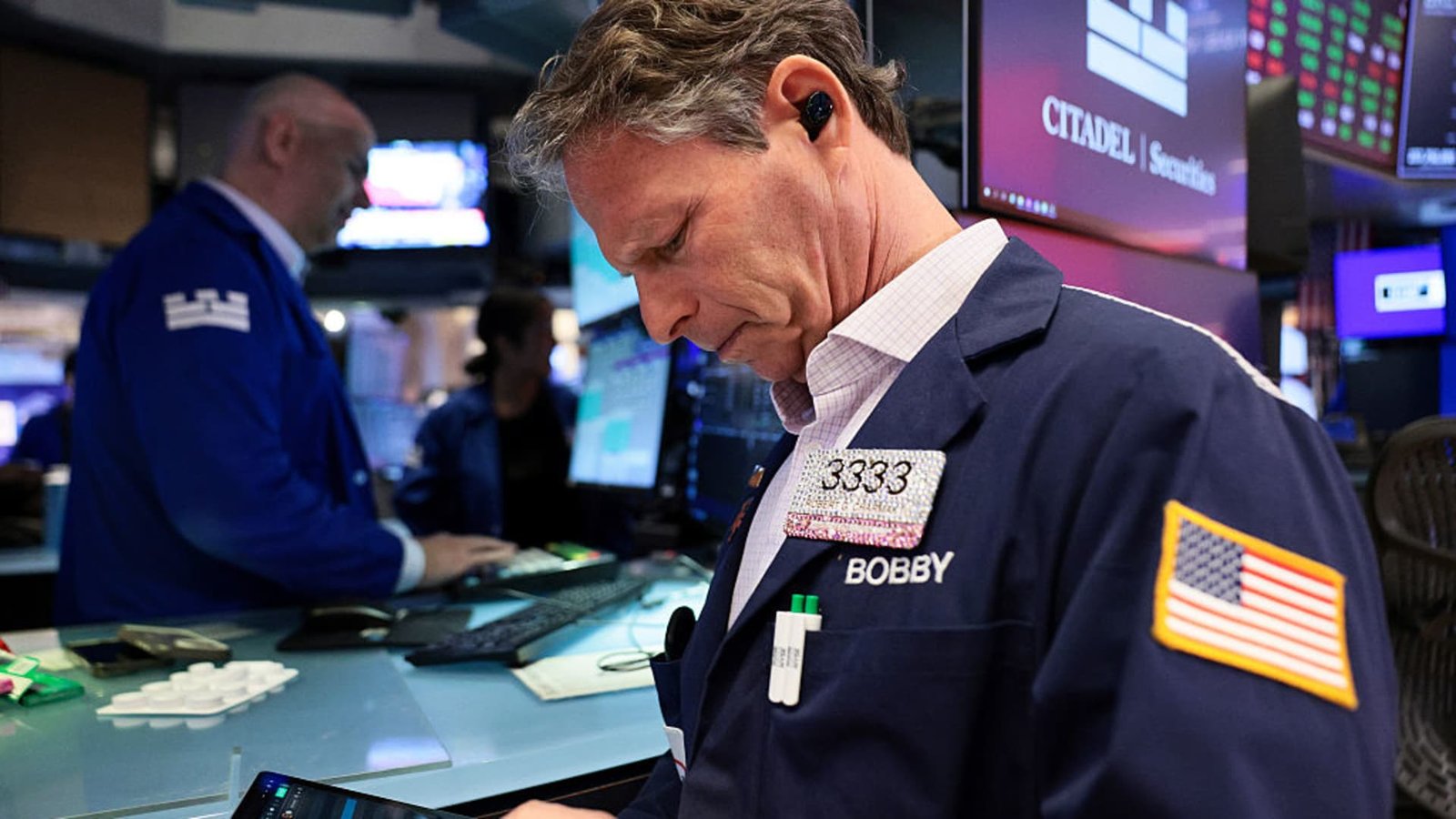
Traders work on the floor of the New York Stock Exchange during morning trading on April 08, 2026 in New York City.
Michael M. Santiago | Getty Images
S&P 500 futures rose slightly on Friday, with the index on pace to post a solid weekly gain, as traders kept an eye on the fragile two-week ceasefire between the U.S. and Iran.
Futures linked to the broad market index traded up 0.1%, while Nasdaq 100 futures were up 0.2%. Futures tied to the Dow Jones Industrial Average were around the flatline.
The major averages are on pace for solid weekly gains. The S&P 500 has jumped more than 3% through Thursday’s close, tracking for its best week since November. The Dow has gained more than 3% week to date as well, while the Nasdaq is on pace to rise more than 4%.
President Donald Trump on Thursday warned that Iran should not charge fees to oil tankers that are traveling through the Strait of Hormuz, writing in a post on Truth Social: “They better not be and, if they are, they better stop now!”
Oil prices were little changed as concerns around the strait’s reopening hovered over the market. West Texas Intermediate crude futures were last trading above $97 a barrel, and international benchmark Brent crude futures were last above $95 a barrel.
Stocks advanced in the prior trading day, extending their gains this week after Trump agreed to pause attacks on Iran for two weeks. Oil prices came off their highs of the day and the S&P 500 rose after Israeli Prime Minister Benjamin Netanyahu said that the country had agreed to negotiate with Lebanon “as soon as possible.”
Tehran’s parliamentary speaker Mohammad Bagher Ghalibaf had cited Israel’s continued attacks on Lebanon as a violation of the ceasefire agreement between the U.S. and Iran.
British Prime Minister Keir Starmer recently called Israel ordering strikes on Lebanon “wrong.” He has also said that he is “fed up” over energy bills in the U.K. moving up and down as a result of actions made by Trump and Russian President Vladimir Putin.
On Tuesday night, Trump agreed to a two-week extension of his deadline for Iran to reopen the strait. The Middle East conflict, which has already been going on for five weeks, resulted in the closure of the key waterway.
Stocks surged on Wednesday following the news of the ceasefire, with all three major indexes jumping more than 2%. The Dow notched its best day since April 2025.
Stephen Parker, co-head of global investment strategy at J.P. Morgan Private Bank, believes that the relief rally has sustainable legs going forward.
“The size of the drawdown that we’ve seen in equity markets, particularly in the U.S., probably doesn’t feel big enough relative to the move and the shock that we saw in energy markets, but I think that’s reflective of a view that energy prices are likely to come down,” he said on CNBC’s “Closing Bell: Overtime” on Thursday afternoon.
“Our base case is one where energy prices continue to gradually move lower over the next three to six months,” he added. “We take a little bit of a hit to growth, a little bit of a pickup in inflation, but overall, that’s still a very constructive environment for equities, particularly as we get into earnings season, which we think will be really positive.”
March’s consumer price index reading showed that inflation was tame when excluding energy prices. Core CPI increased just 0.2% for the month and 2.6% compared with a year ago, coming in below expectations. However, including food and energy prices, inflation was as expected, standing at 0.9% for the month and 3.3% on an annual basis. That incorporated a 10.9% jump in energy costs due to the conflict in the Middle East.