

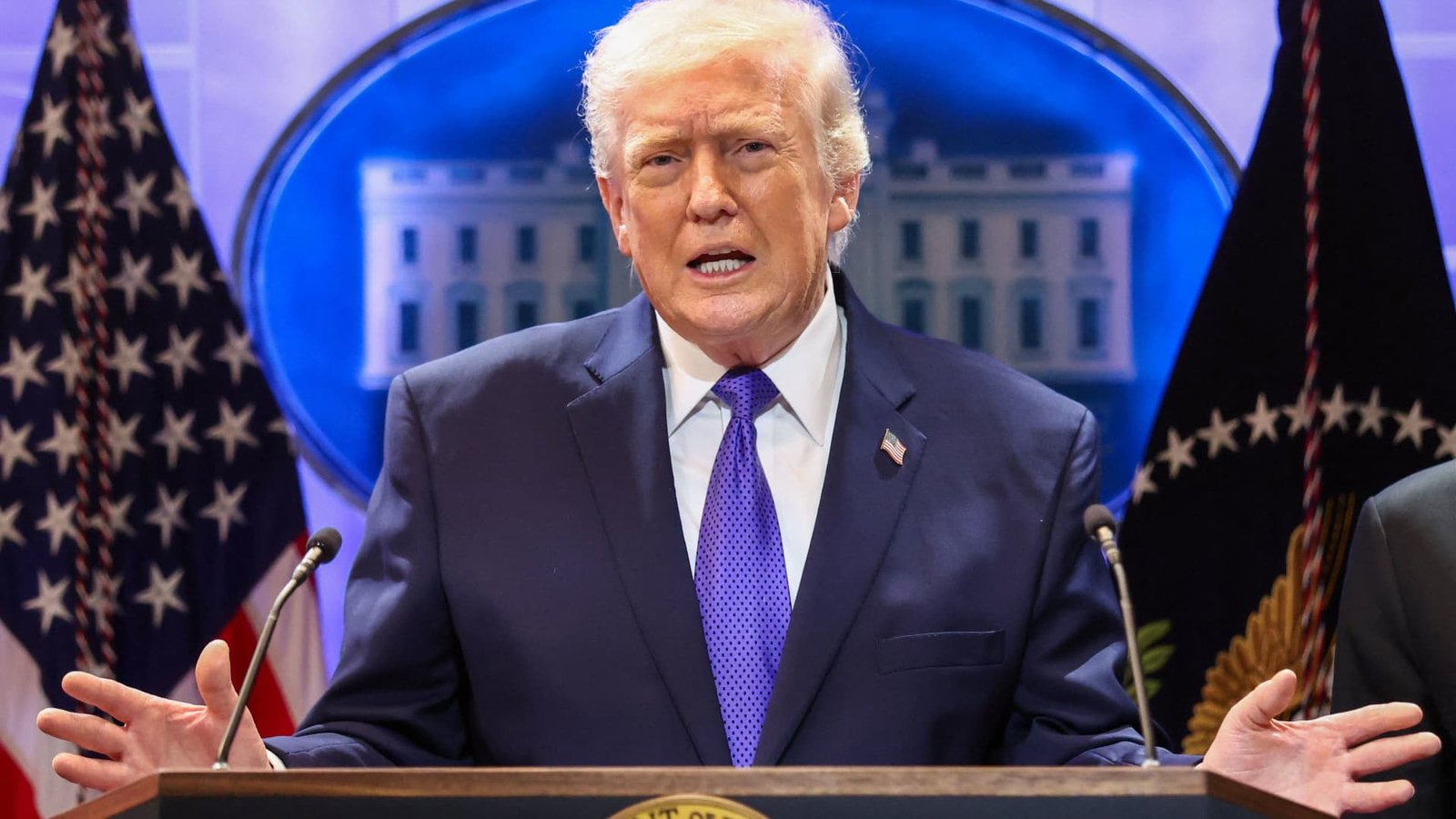
Trump to discuss Iran war during event at White House
Trump is set to make his first live public comments on Iran since the war started, a White House official confirmed.
The president was expected to discuss Iran at a Medal of Honor ceremony at the White House.
— Dan Mangan
UK PM defends decision not to join U.S.-Israeli strikes against Iran following Trump criticism
Prime Minister Keir Starmer, issues a statement regarding the Manchester Synagogue attack, at Downing Street on October 2, 2025 in London, England.
Wpa Pool | Getty Images News | Getty Images
U.K. Prime Minister Keir Starmer has defended his decision to delay accepting a U.S. request to use military bases for strikes on Iranian missile sites.
In a speech to lawmakers in the House of Commons, Starmer said that the use of British military bases is limited to “agreed defensive purposes,” adding that Britain would not be joining the U.S. and Israeli “offensive” strikes against Iran.
His comments follow criticism from Trump, who reportedly accused Starmer of taking “far too long” to accept a U.S. request to use military bases for “defensive” strikes on Iranian missile sites.
“We will continue our defensive actions in the region,” Starmer said Monday.
— Sam Meredith
Trump says military action will ramp up: ‘The big one is coming soon’
U.S. President Donald Trump returns to the White House, after Israel and the U.S. launched strikes on Iran, in Washington, D.C., U.S., March 1, 2026.
Nathan Howard | Reuters
Trump said the U.S. military will soon ramp up its offensive in Iran.
“We haven’t even started hitting them hard,” Trump told CNN’s Jake Tapper in a phone call, the news anchor said Monday morning.
“The big wave hasn’t even happened. The big one is coming soon,” Trump said, according to Tapper, who spoke on air right after the nine-minute call.
The remark followed Trump urging Iran’s citizens — whom he has encouraged to take over the country’s government — to stay inside because “it’s not safe out there,” Tapper said.
The president said that the operations are so far “going very well.”
“We’re knocking the crap out of them,” Tapper said Trump told him.
Asked about how long the conflict might last, Trump told the CNN anchor, “I don’t want to see it go on too long. I always thought it would be four weeks, and we’re a little ahead of schedule.”
Defense Secretary Pete Hegseth told reporters at the Pentagon earlier Monday that the war’s timeline could shift longer or shorter than the four-week estimate Trump has previously floated.
— Kevin Breuninger
Caine says more U.S. forces being deployed, Hegseth won’t say how long war could last
U.S. Secretary of War Pete Hegseth (L) speaks as Chairman of the Joint Chiefs of Staff General Dan Caine (R) listens during a news conference at the Pentagon on March 2, 2026 in Arlington, Virginia.
Alex Wong | Getty Images
The U.S. is poised to send additional forces to the Middle East today, military leaders said, while suggesting that the war could continue longer than the four- to five-week timeline that Trump floated a day earlier.
In preparation for possible armed conflict against Iran, the U.S. in recent weeks had preemptively deployed thousands of service members from all military branches, along with dozens of refueling tankers and multiple carrier strike groups, while establishing necessary supply flows, Joint Chiefs of Staff Chairman Gen. Dan Caine said at the Pentagon.
“And the flow of forces continues today. In fact, [Commander of U.S. Central Command Adm. Brad] Cooper will receive additional forces even today,” Caine said.
Asked how many troops are currently involved and how many are expected to be sent, Caine declined to be specific.
But he said “more tactical aviation” is entering the theater, and added, “I think we’re just about where we want to be in terms of total combat capacity and total combat power.”
Hegseth then responded to a question about Trump’s remark Sunday that the operations could last around four weeks.
“It’s the typical, typical NBC sort of gotcha-type question,” Hegseth said.
“President Trump has all the latitude in the world to talk about how long it may or may not take. Four weeks, two weeks, six weeks. It could move up. It could move back. We’re going to execute at his command the objectives we’ve set out to achieve,” Hegseth said.
— Kevin Breuninger
Stocks open in the red following U.S.-Israel strikes on Iran
Traders work on the floor of the New York Stock Exchange during morning trading on February 27, 2026 in New York City.
Michael M. Santiago | Getty Images
Stocks started the week off with losses after the U.S. and Israel attacked Iran over the weekend.
The Dow Jones Industrial Average dropped 543 points, or 1.1%. The S&P 500 lost 1.1%, and the Nasdaq Composite futures declined 1.6%.
— Sean Conlon
Flight cancellations continue to grow
Travellers check on a departure board displaying cancelled flights to Middle East countries amid the U.S.-Israel conflict with Iran, at Heathrow Airport Terminal 4, in Greater London, Britain, March 2, 2026.
Isabel Infantes | Reuters
Airlines have canceled thousands of flights for the week in the Middle East.
The cancellations continued Monday, with 1,560 flights scrubbed, or 41.28% of those scheduled for arrival in Middle East countries, according to aviation data firm Cirium.
Hundreds of thousands of passengers remain stranded.
The United Arab Emirates had the most flight cancellations in the region, with 774, according to Cirium. Dubai International Airport in the UAE is one of the busiest airport hubs in the world.
The airport authority that owns and manages airports in Dubai said a small number of flights would be permitted to operate from Dubai International and Dubai World Central – Al Maktoum International, but advised travelers to check with their airlines.
Airspace remains closed in many Middle Eastern countries. Cirium noted that some smaller airlines have not updated their schedules to officially cancel flights or have simply not flown the flights.
— Michele Luhn
New Norwegian Cruise CEO says long-term effects of oil price spike uncertain
Norwegian Sky, a 77,104 GT Sun-class cruise ship owned and operated by Norwegian Cruise Line, sails the Tagus River after departure from the cruise terminal on September 02, 2025, in Lisbon, Portugal.
Horacio Villalobos | Corbis News | Getty Images
New Norwegian Cruise Line CEO John Chidsey said the company is closely monitoring fuel costs as crude oil prices jump.
“As for fuel prices, the longer-term impact remains uncertain,” he said on an earnings call Monday. “However, we are currently approximately 51% hedge for 2026, 27% hedge for 2027, which helps mitigate near-term volatility.”
Chidsey said the company does not currently have cruises operating in the affected areas but will be monitoring the situation closely.
— Contessa Brewer and Michele Luhn
Oil stuck as transit in the Strait of Hormuz comes to a halt
FILE: Oil tanker SC Hong Kong is seen off the port of Bandar Abbas, southern Iran.
Atta Kenare | Afp | Getty Images
As transit through the Strait of Hormuz comes to a standstill, oil is stuck on vessels that can’t exit the Persian Gulf.
Approximately 77 million barrels of oil have been loaded onto tankers currently sitting in the Persian Gulf, according to Kpler data. The oil waiting to transit is at its highest level in six years, and there are an additional 88 million barrels of capacity on vessels still in the region.
Together, it represents about 10 days’ worth of shipments, the firm said, meaning there’s a “finite buffer before the halt in vessel movements severely bottlenecks global exports.”
Brent crude, the international oil benchmark, last traded at $79.22 per barrel, up 8.7%.
— Pippa Stevens
More U.S. casualties expected as ‘major combat operations’ continue: Gen. Caine
Chairman of the Joint Chiefs of Staff General Dan Caine holds a briefing amid the U.S.-Israeli conflict with Iran, at the Pentagon in Washington, D.C., U.S., March 2, 2026.
Elizabeth Frantz | Reuters
Air Force Gen. Dan Caine, chairman of the Joint Chiefs of Staff, said the U.S. expects to sustain more military casualties as the widespread fighting in the Middle East continues.
“This is not a single overnight operation,” Caine said at the Pentagon.
“The military objectives that [U.S. Central Command] and the Joint Force have been tasked with will take some time to achieve, and in some cases, will be difficult and gritty work,” he said.
“We expect to take additional losses and, as always, we will work to minimize U.S. losses.”
Defense Secretary Pete Hegseth gave a similar warning: “An effort of this scope will include casualties. War is hell.”
— Kevin Breuninger
Hegseth: This is not a regime-change war, ‘but the regime sure did change’
US Defense Secretary Pete Hegseth speaks during a press conference on US military action in Iran, at the Pentagon in Washington, DC, on March 2, 2026.
Brendan Smialowski | Afp | Getty Images
U.S. Defense Secretary Pete Hegseth said that the war in Iran is not being waged in order to overthrow Tehran’s ruling regime — but he pointed to the deaths of Iranian leaders that have resulted from the operations so far.
“Turns out the regime who chanted ‘Death to America’ and ‘Death to Israel’ was gifted death from America and death from Israel,” Hegseth said during a press briefing at the Pentagon.
“This is not a so-called regime-change war, but the regime sure did change, and the world is better off for it,” Hegseth said.
The “clear” mission of the U.S. campaign dubbed “Operation Epic Fury,” he said, is to destroy Iranian military threats and nuclear capabilities.
“Israel has clear missions as well, for which we are grateful,” Hegseth said.
— Kevin Breuninger
Fuel prices surge as tanker traffic in Strait of Hormuz comes to a standstill
The Strait of Hormuz isn’t only vital for oil — it’s a key waterway for refined products, too, and prices are outpacing the gains in crude. While oil jumped about 9% on Monday morning, European diesel prices surged 20%.
Tanker traffic through the narrow waterway has come to a standstill, while Saudi Arabia’s Ras Tanura — a key refinery in the region — was hit by a drone.
Heating oil futures in the U.S., which are a proxy for diesel prices, jumped 14.5% on Monday morning. The fuel is often referred to as the workhorse of the economy, given that it powers trucks and trains.
Gasoil futures spike amid disruptions in the Strait of Hormuz.
Fourth U.S. service member killed in Iran conflict
Four U.S. service members have now died as part of the military conflict in Iran and the Middle East, U.S. Central Command said Monday morning.
The latest fallen service member succumbed to their injuries after being “seriously wounded during Iran’s initial attacks,” Central Command said in a post on X.
“Major combat operations continue and our response effort is ongoing. The identities of the fallen are being withheld until 24 hours after next of kin notification,” it said.
— Kevin Breuninger
Pentagon to brief press on Iran strikes as conflict expands
Senior U.S. military officials are set to brief reporters at the Pentagon about the latest developments on their military operations in the Middle East.
Defense Secretary Pete Hegseth and Chairman of the Joint Chiefs of Staff Gen. Dan Caine will lead the briefing, which is set to begin at 8 a.m. ET.
— Kevin Breuninger
FedEx warns of delays after suspending Middle East flights
In this photo FedEx logo is seen in Washington D.C., United States on February 16, 2023.
Celal Gunes | Anadolu Agency | Getty Images
FedEx warned customers that shipments could be delayed after it suspended flights at major airports in the Middle East. The shipping giant operates a hub in Dubai and, in February 2024, it announced a $350 million investment in a facility there.
Pickups and deliveries in Bahrain, Kuwait, Iraq, Qatar and United Arab Emirates “have been temporarily suspended until further notice,” FedEx said, warning that other markets in the area could experience delays.
“We are closely monitoring the situation and will resume services as soon as it is safe to do so,” FedEx said.
— Leslie Josephs
QatarEnergy halts LNG production after military attacks
QatarEnergy announced in a statement seen by CNBC that it has “ceased production of liquefied natural gas” and “associated products,” citing military attacks on the company’s operating facilities in Ras Laffan Industrial City and Mesaieed Industrial City in the state of Qatar.
QatarEnergy is one of the world’s largest LNG producers, with a total production capacity of 77 million metric tons per annum.
Qatar has been targeted by Iranian counterstrikes on its capital Doha, its airport, and other civilian and state infrastructure.
— Emma Graham
Russia and China condemn strikes on Iran, but offer no help
Russian President Vladimir Putin (C) enters the hall during the meeting with Iranian President Masoud Pezeshkian (not pictured), October 11, 2024, in Ashgabat, Turkmenistan.
Contributor | Getty Images News | Getty Images
Officials from Russia and China’s Foreign Ministries have condemned the U.S.-led strikes but have stopped short of pledging military or civilian support to Tehran. That exposes the hard limits of Iran’s “strategic partnerships” with Moscow and Beijing, experts say.
Read more on the story here: Why Iran should not count on allies Russia and China to come to its aid
— Holly Ellyatt
How a Strait of Hormuz crisis could ripple through global shipping markets
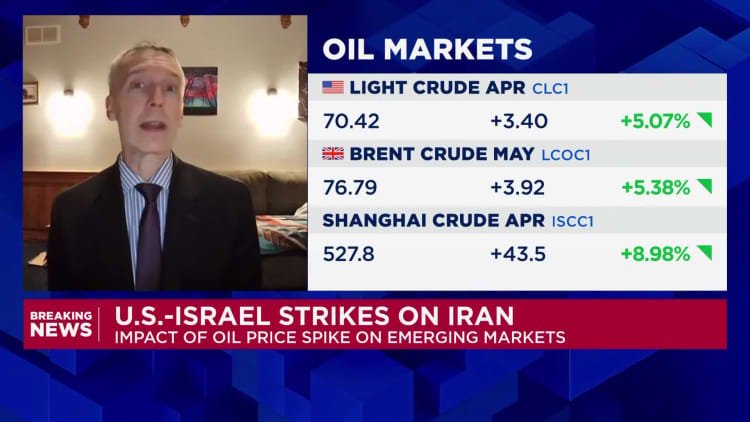
Container shipping giants have been forced to issue fresh guidance for vessels transiting maritime corridors in the Middle East, including the strategically vital Strait of Hormuz.
The waterway, which is located between Oman and Iran and connects the Persian Gulf with the Arabian Sea, is considered one of the most important arteries for global trade.
Danish shipping company Maersk and German container shipping firm Hapag-Lloyd both said over the weekend that they would suspend all vessel crossings in the Strait of Hormuz until further notice, amid the deteriorating security situation.
Peter Sand, chief analyst at Xeneta, told CNBC on Monday that higher container shipping rates should be factored in for the Middle East region at least for as long as the conflict persists, adding there is “no real alternative” to ocean freight.
— Sam Meredith
U.S. confirms 3 fighter jets downed over Kuwait in ‘apparent friendly fire incident’
Three U.S. F-15 fighter jets crashed over Kuwait in what looks to be a friendly fire incident, U.S. Central Command said Monday. None of the aircrew were hurt.
“During active combat — that included attacks from Iranian aircraft, ballistic missiles, and drones — the U.S. Air Force fighter jets were mistakenly shot down by Kuwaiti air defenses,” Centcom said in a statement.
“All six aircrew ejected safely, have been safely recovered, and are in stable condition. Kuwait has acknowledged this incident, and we are grateful for the efforts of the Kuwaiti defense forces and their support in this ongoing operation.”
The cause of the incident is under investigation and additional information will be released as it becomes available, Centcom said.
— Azhar Sukri
A ‘watershed’ moment for the Middle East: Carl Bildt’s take on the crisis
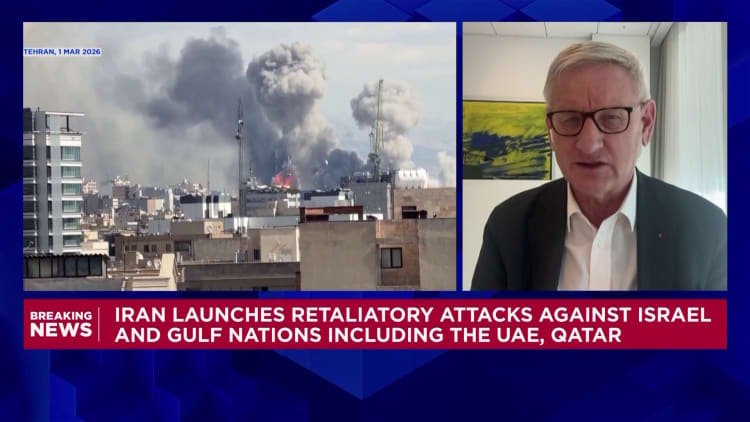
“When and how will this end?” is the question everyone is asking as the Middle East crisis gathers pace with no clear end in sight, Carl Bildt, former prime minister of Sweden and the co-chair of the European Council on Foreign Relations, told CNBC on Monday.
“The end of this particular conflict, if there is such a thing, will, of course, shape both Iran and the region for years to come. Key question is, will the regime survive or will it collapse?” Bildt told CNBC’s “Squawk Box Europe.”
“If [the Iranian regime] survives, in what particular form and what particular shape, and if it collapses, is that a collapse into chaos, or is that collapse into a transition to something that is somewhat more stable?” he said.
The collapse of a regime overseeing a country of 90 million people would have “profound implications for the stability of the entire region” Bildt said. “So it is a watershed event in the history of the region, with a highly uncertain outcome.”
Bildt called the U.S.’ decision to strike Iran a “war of choice” rather than necessity, and one which was borne out of pressure from Israel and sensing a weakened Iranian regime amid ongoing protests. He said Iran’s decision to strike back at targets across the Middle East, and beyond U.S. bases, was “surprising, but also highly disturbing.”
— Holly Ellyatt
Emirates, Etihad suspend all flights as Middle East travel disruptions worsen
An Airbus A350-941 commercial jet, operated by Emirates Airline, at the Paris Air Show in Paris, France, on Monday, June 16, 2025.
Matthieu Rondel | Bloomberg | Getty Images
Emirates and Etihad have temporarily halted all flights into and out of their hubs in the United Arab Emirates on Monday.
“Due to multiple regional airspace closures, Emirates has temporarily suspended all operations to and from Dubai, up until 1500hrs UAE time on Tuesday, 3 March,” Emirates said in an advisory on its website.
“The situation remains dynamic and is assessed continuously. We urge all customers to review the latest operational updates on emirates.com and check their email for any notifications about changes or cancellations to their flights before travelling to the airport,” Emirates said.
The UAE’s other major carrier, Etihad Airways, also said it was suspending flights.
“Regional airspace closures continue to impact Etihad Airways’ operations, and all flights to and from Abu Dhabi are suspended until 14:00 UAE time on Tuesday 3 March,” Etihad said on its website.
Meanwhile, Jordan announced a partial and temporary closure of its airspace.
— Azhar Sukri and Emma Graham
Oil likely to hold near $80 unless infrastructure is hit, analyst says
A cargo ship is pictured off coast city of Fujairah, in the Strait of Hormuz in the northern Emirate on February 25, 2026.
Giuseppe Cacace | Afp | Getty Images
Amrita Sen, founder of Energy Aspects, told CNBC’s “Europe Early Edition” this morning that oil markets are likely to hold at around $80 a barrel for now after an initial spike, noting, “we’ve kind of stabilized a little bit,” and adding, “I do think we will hold around that 80 level for some time right now,” as there has been no direct hit to core Gulf energy infrastructure.
The bigger concern is the Strait of Hormuz. Sen said Energy Aspects calculates that “about 15 million barrels” per day of oil and “about 80 million tonnes of LNG” passed through the strait last year. While she does not expect Iran to formally shut the waterway, she warned that “what the U.S. will not be able to do is control these one-off attacks on tankers.”
Those incidents are “enough to kind of make the market extremely cautious about sending vessels in,” creating delays and disruption.
Sen said prices would likely stay near current levels unless there is “actual damage to energy infrastructure.” Without that, she said, the market holds steady — but “further damage and yes, we go up.”
— Spriha Srivastava
How Iran chooses its supreme leader, and who could be next?
FILE PHOTO: Iran’s Supreme Leader Ayatollah Ali Khamenei speaks in Tehran January 8, 2007.
Stringer Iran | Reuters
Ayatollah Ali Khamenei’s death following joint U.S.-Israeli airstrikes has thrust Iran’s leadership into the urgent process of selecting a new supreme leader.
Under Iran’s constitution, the supreme leader is appointed by the Assembly of Experts. When the position becomes vacant, the assembly convenes to deliberate and select a successor. The decision requires a simple majority vote.
In the interim, a provisional three-member leadership council assumes the supreme leader’s duties until a replacement is formally appointed.
On Sunday, local media reported that the temporary council comprises President Masoud Pezeshkian, Judiciary Chief Gholam-Hossein Mohseni-Ejei and Ayatollah Alireza Arafi, who serves as the Guardian Council’s representative.
On Polymarket, traders are pricing Mohseni-Ejei as the narrow front-runner at roughly 18%. Other top contenders include Arafi and Iranian cleric Hassan Khomeini.
Read the full story here.
— Lee Ying Shan
Saudi Aramco’s Ras Tanura refinery hit by drone: Industry source
Oil pipelines sit on the quayside beside the Arabian Sea at the North Pier terminal in Saudi Aramco’s Ras Tanura oil refinery and oil terminal in Ras Tanura, Saudi Arabia, on Monday, Oct. 1, 2018. Photographer: Simon Dawson/Bloomberg via Getty Images
Bloomberg | Bloomberg | Getty Images
Saudi Aramco’s Ras Tanura refinery has been hit by a drone, an industry source has told CNBC.
The facility had been closed as a precaution amid the ongoing conflict in the region.
The source says a small fire has been contained and is under control.
Saudi Aramco did not immediately respond to an emailed request for comment.
— Emma Graham
European stocks set to slump
European stocks are expected to start the new trading week firmly in negative territory as global markets drop after the U.S. and Israel launched widespread attacks on Iran at the weekend.
The U.K.’s FTSE index is seen opening 0.6% lower, Germany’s DAX down 1.5%, France’s CAC 40 down 1.4% and Italy’s FTSE MIB 1.2% lower, according to data from IG. Read more.
— Holly Ellyatt
AWS hit with outage after ‘objects’ hit UAE data center
Amazon Web Services said Sunday it was working to fix a disruption it suffered in the United Arab Emirates after unidentified “objects” struck one of its data centers, sparking a fire and leading to a power cut.
It comes as the UAE is being targeted by Iran’s retaliatory missile and drone strikes following U.S. and Israeli attacks on the country over the weekend.
AWS said on its health dashboard that the issue had led to some ongoing connectivity disruptions, but customers were able to reroute to unaffected zones.
In its latest update, AWS said it still did not have an estimated time for power restoration. “We are investigating additional connectivity issues and error rates in the ME-CENTRAL-1 Region [UAE],” the company said.
— Dylan Butts
Blasts heard in Dubai, Abu Dhabi for a third day
Burj Al Arab stands, after an Iranian attack, following United States and Israel strikes on Iran, in Dubai, United Arab Emirates, March 1, 2026.
Amr Alfiky | Reuters
Loud blasts were heard for a third day in Dubai and Abu Dhabi. CNBC’s team in the United Arab Emirates said the explosions occurred shortly after 9 a.m local time.
The UAE’s Ministry of Defence said in a post on X that the country’s air force and air defence units had intercepted “165 ballistic missiles, two cruise missiles and 541 Iranian drones since the start of the Iranian attack.”
Among the locations targeted were Dubai’s iconic Burj Al Arab hotel, the Fairmont Hotel on the Palm, Jebel Ali Port, Abu Dhabi’s Etihad Towers and the international airports in the two emirates.
— Emma Graham
Iran security chief Ali Larijani rejects U.S. talks, blames Trump for chaos
Iran’s security chief Ali Larijani attends a ceremony by the Lebanese Shiite movement Hezbollah marking the first anniversary of Israel’s assassination of their longtime leader Hassan Nasrallah, in Beirut’s southern suburbs on September 27, 2025.
Anwar Amro | Afp | Getty Images
Iran’s security chief Ali Larijani said that Tehran has no plans to engage in negotiations with the United States.
“We will not negotiate with the United States,” the former adviser to the late supreme leader said in a post on X, dismissing reports that it is seeking to restart negotiations with Washington.
“Trump has plunged the region into chaos with his ‘false hopes’ and is now worried about further casualties of American troops,” he wrote in an earlier post.
— Lee Ying Shan
Kuwait reports drone interceptions as Iran continues retalitory strikes
An Iran-made unmanned aerial vehicle (UAV), the Shahed-136, is displayed in a rally commemorating the 47th anniversary of the Islamic Revolution’s victory in Azadi (Freedom) Square in western Tehran, Iran, on February 11, 2026.
Nurphoto | Nurphoto | Getty Images
Kuwait’s Director General of Civil Defense said Monday that the country’s Air Defense forces had successfully intercepted a majority of hostile Iranian drones approaching its borders through maritime routes.
The Kuwaiti official also confirmed that no injuries were reported from the interception operations, according to a report by state-backed media.
According to the Gulf Cooperation Council, Iran unleashed waves of drones and missiles on several Arab nations, including Kuwait, the United Arab Emirates, Bahrain, Saudi Arabia, Oman, and Qatar, over the weekend.
Since then, countries like Bahrain and the UAE have reported successful interceptions of hundreds of Iranian drones.
According to Bahrian officials, the attacks have included Iran’s Shahed-136 type drones, a cheap, locally made drone that can act like a guided missiles that travel to a predetermined target.
— Dylan Butts
UAE recalls ambassador, closes Tehran embassy after missile strikes
The United Arab Emirates recalled its ambassador from Iran Monday and shuttered its embassy in Tehran in response to missile strikes over the weekend that it said targeted civilian infrastructure, including Jebel Ali Port and airports in Dubai and Abu Dhabi.
The UAE Ministry of Foreign Affairs also summoned the Iranian Ambassador and delivered a note of protest over what it described as “terrorist attacks.”
Abu Dhabi downgraded ties with Tehran in 2016 after attacks on Saudi diplomatic missions in Iran. Relations deteriorated further after the UAE joined the Abraham Accords in 2020.
In recent years, however, ties had begun to improve. The UAE’s national security advisor, Sheikh Tahnoon bin Zayed al Nahyan, visited Tehran in 2021, in a rare move aimed at warming ties.
About half a million Iranians are estimated to live in the Emirates, many of them in Dubai. The Emirate is home to an Iranian hospital, at least one Shiite mosque in Jumeirah and numerous businesses selling Iranian goods. Despite periodic diplomatic strains, the two countries have maintained significant trading ties. Iran and the UAE are also at odds over three contested islands in the Persian Gulf.
Saudi Arabia, which recently restored diplomatic relations with Iran in 2023 under a deal brokered by China, also condemned the attacks on the Gulf States and summoned its ambassador from Tehran.
— Emma Graham
U.S. and Gulf nations issue joint warning to Iran, vowing ‘self- defense’
A group of Middle Eastern countries and the U.S. issued a joint statement Sunday night stateside, condemning Iran’s missile and drone attacks and affirming their right to self-defense.
“The Islamic Republic’s actions represent a dangerous escalation that violates the sovereignty of multiple states and threatens regional stability. The targeting of civilians and of countries not engaged in hostilities is reckless and destabilizing behavior,” according to the statement.
“We stand united in defense of our citizens, sovereignty, and territory, and reaffirm our right to self-defense in the face of these attacks. We remain committed to regional security and commend the effective air and missile defense cooperation that has prevented far greater loss of life and destruction.”
— Anniek Bao
Marco Rubio to brief congressional leaders as Iran conflict escalates
U.S. Secretary of State Marco Rubio testifies before a Senate Foreign Relations Committee hearing titled “U.S. Policy Towards Venezuela”, on Capitol Hill in Washington, D.C., U.S., Jan. 28, 2026.
Jonathan Ernst | Reuters
U.S. Secretary of State Marco Rubio is scheduled to update top leaders of the Senate and House at 4 p.m. ET on Monday.
This comes on the back of coordinated strikes by the United States and Israel on Iran, and Tehran’s retaliation that has seen it target U.S. bases in the region, including those in the UAE and Saudi Arabia.
— Lee Ying Shan
Israeli forces retaliate against Lebanon-based militant group Hezbollah
Smoke rise over Southern Lebanon after an Israeli bombardment, as seen from a position on the Israeli side of the border on March 2, 2026 near the border with Lebanon in northern Israel.
Amir Levy | Getty Images
Israel Defense Forces said they were retaliating against Lebanon-based militant group Hezbollah for targeting Israeli civilians.
“In response to projectile fire toward northern Israel, the IDF is striking Hezbollah targets across Lebanon,” the IDF said in statement posted on X.
“Hezbollah is operating on behalf of the Iranian regime, opening fire against the Israeli civilians, and bringing ruin to Lebanon. IDF troops have prepared for such a scenario as part of Operation ‘Roaring Lion’, and are prepared for an all-fronts scenario,” the statement read.
The IDF in 2024 killed Hezbollah’s leader Hassan Nasrallah, who had led the Iran-backed militant group for more than three decades.
— Vinay Dwivedi
U.K. lets U.S. use bases to target Iranian missiles after ‘scorched earth’ strategy
British Prime Minister Sir Keir Starmer speaks following the incident at Heaton Park Hebrew Congregation synagogue in Crumpsall, Manchester, at 10 Downing Street, London, Britain, Oct. 2, 2025.
James Manning | Via Reuters
The U.K. has granted permission for the U.S. to use its military bases in the Middle East in an effort to destroy Iranian missiles and missile launchers, Prime Minister Keir Starmer said in an address on Sunday posted to X.
Starmer framed his decision as one of self-defense.
The move follows Iranian strikes across the region that have put British interests, citizens and allies in harm’s way, despite the U.K. not having been involved in the initial U.S. and Israeli attacks on Iran, the prime minister said.
“We all remember the mistakes of Iraq, and we have learned those lessons,” Starmer said. “We were not involved in the initial strikes on Iran, and we will not join offensive action now.”
“But Iran is pursuing a scorched earth strategy,” he added. “So we are supporting the collective self defense of our allies and our people in the region. Because that is our duty to the British people. It is the best way to eliminate the urgent threat and prevent the situation spiraling further.”
Against this backdrop, the U.K.’s decision to allow the U.S. to use its bases is consistent with international law, he said.
— Greg Iacurci